Research
Working Papers
Abstract
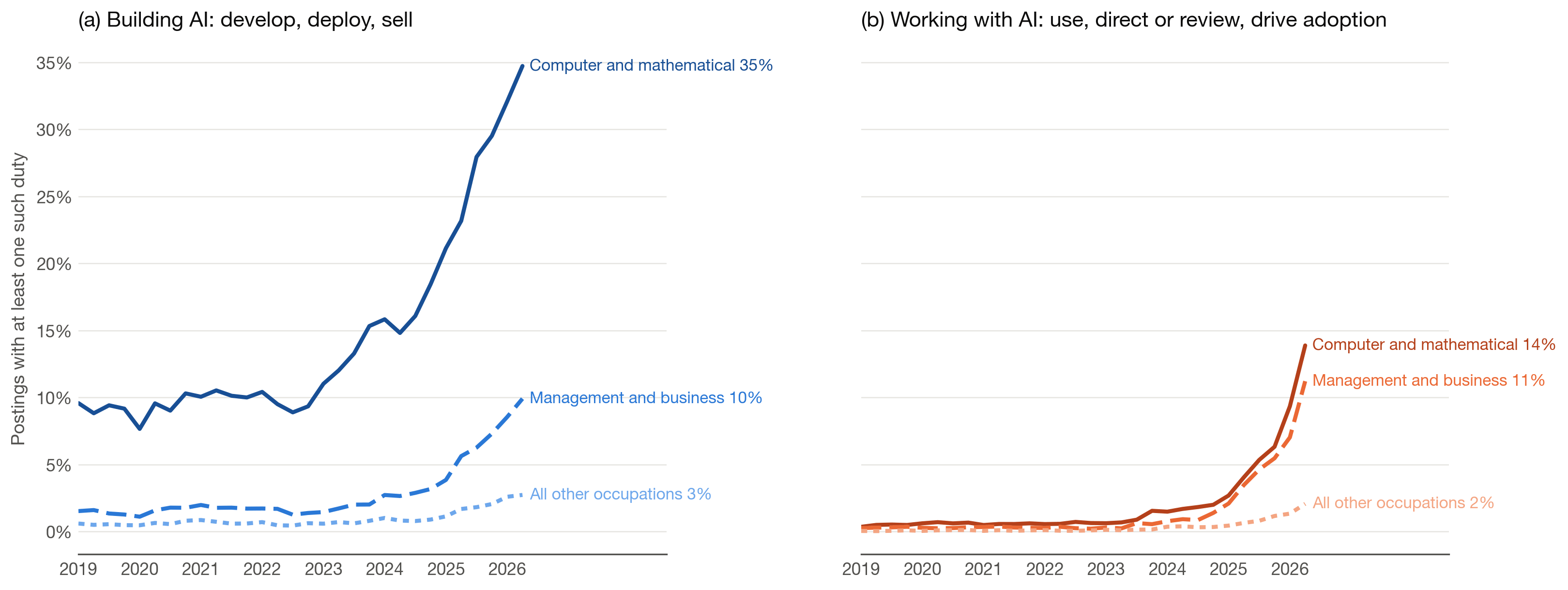
Whether generative AI raises or lowers the demand for labour depends in part on the new work it creates. I measure the new tasks that employers advertise in 18.4 million duty statements from US job postings, 2019–2026, drawn from a new dataset of applicant-tracking-system pages archived by Common Crawl. Duty statements with no close counterpart in early-2019 postings are flagged, and a language model separates new work—a new activity or a new object of work—from familiar tasks done with new tools and from variants of old duties. In the third of occupations that use AI most, new work rose about fivefold, from 0.5 to 2.6 per 100 duty lines between 2022 and 2026, and most of the increase is work on AI itself: building and governing AI, directing it and driving its adoption. Working with AI, rather than building it, rose from 4% of AI duties in 2019–23 to 22% in 2026, but about two-fifths of it asks workers only to use AI tools in their own work, which changes how familiar tasks are done rather than what they are. Beyond new work, existing tasks are crossing occupational lines: postings that ask for technical and data tools, such as dashboards, in occupations whose duties did not name them in 2019–20 rose about threefold between 2022 and 2026. Postings with AI duties advertise higher pay, though most of the premium is accounted for by the firms and job titles that post them. Most evidence on generative AI concerns the tasks it can perform; reading duty statements measures the work it creates as employers advertise it, before job titles and official task lists record it.
Abstract
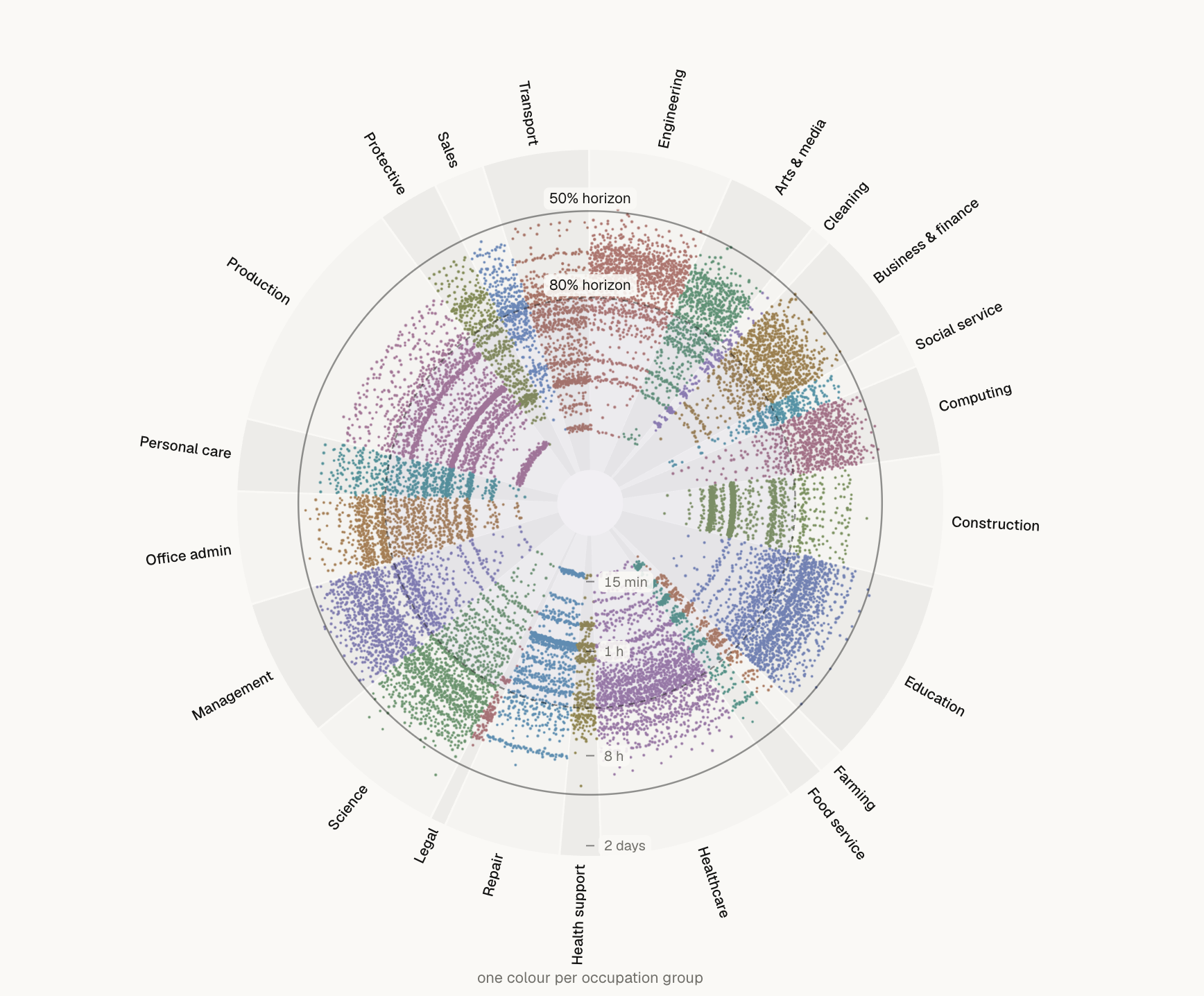
How much work can AI agents perform autonomously? A key predictor of whether an AI agent can complete a task is how long the task takes a human, and on the benchmarks of METR (Model Evaluation and Threat Research) the time horizon of frontier models has doubled roughly every four months since 2023. I combine METR’s agent success curves with human task-duration estimates from the Anthropic Economic Index across 18,796 tasks in O*NET, the US Occupational Information Network, weighting each task’s share of the US wage bill by the probability of autonomous completion that METR’s curves imply. Tasks accounting for 46 percent of the US wage bill are expected to succeed under the latest frontier model, more than three times the 14 percent at the start of 2025. Coverage of individual jobs is broad but partial: no occupation reaches 90 percent. Unlike exposure rubrics, which ask whether AI could speed up a task, or usage data, which conflate capability with adoption, the measure gives macroeconomic models a capability-based value for the share of work AI could automate, one that moves with the frontier.
Abstract
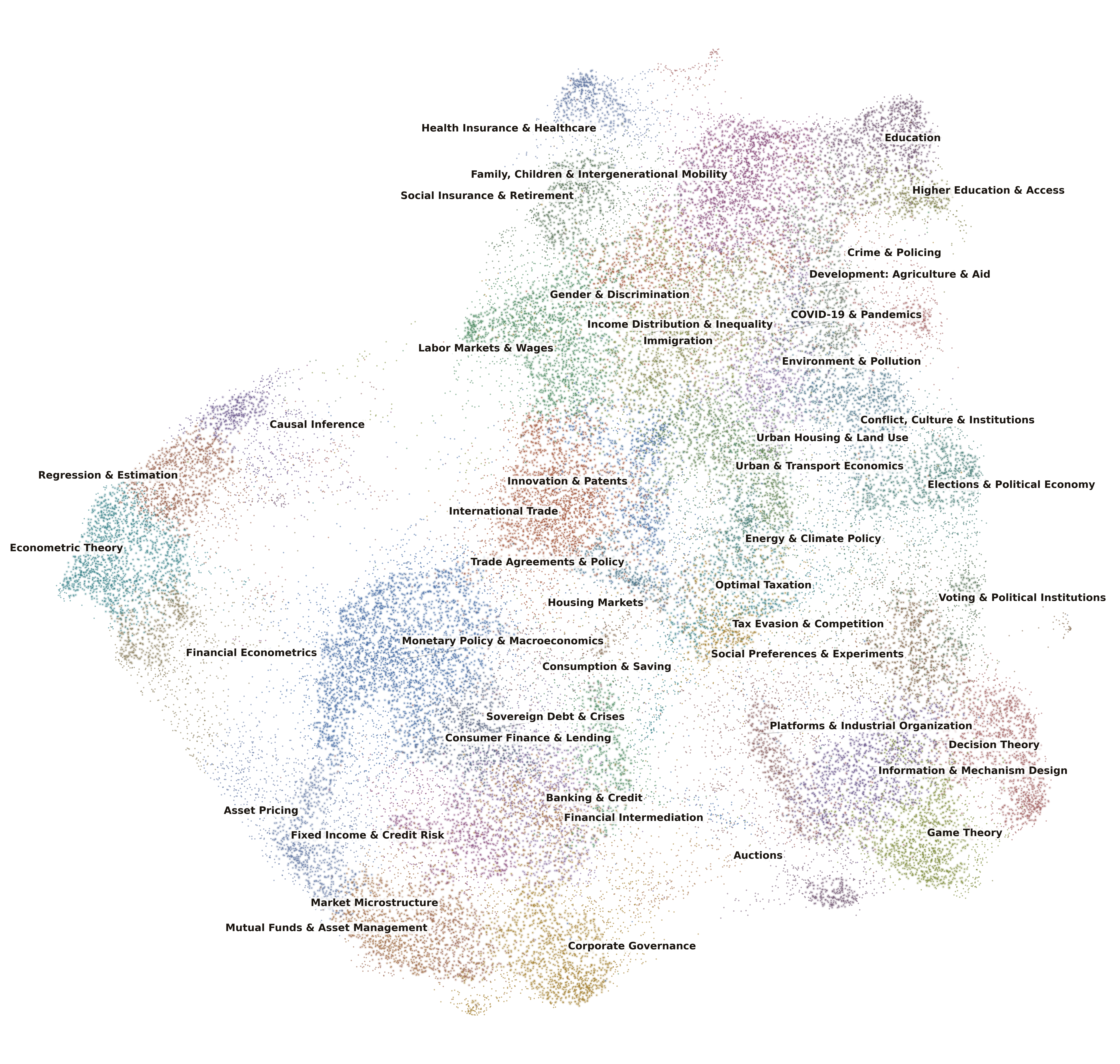
How is economics evolving as a discipline—are its research areas converging or fragmenting, and what characterizes those that grow? I place 50,000 research articles published in 24 leading economics journals and the NBER working paper series between 2000 and 2026 on a map in which papers on similar topics sit near one another, and group them from the bottom up into 46 research clusters. Roughly a fifth of publication share moved across fields, away from macroeconomics, finance, and microeconomic theory and toward applied micro areas such as development, health, labor, and political economy. Consistent with the credibility revolution, the same shift appears within fields: in econometrics, the share of papers on causal inference more than doubled while the share on econometric theory halved. Despite this reallocation, the discipline has not drifted apart. The distances between research clusters are unchanged since 2000, and the degree of collaboration and cross-pollination between fields has increased markedly. Indeed, I show that the research clusters that grew most are those whose researchers and citations reach into distant fields. An interactive version of the map is publicly available.
Abstract
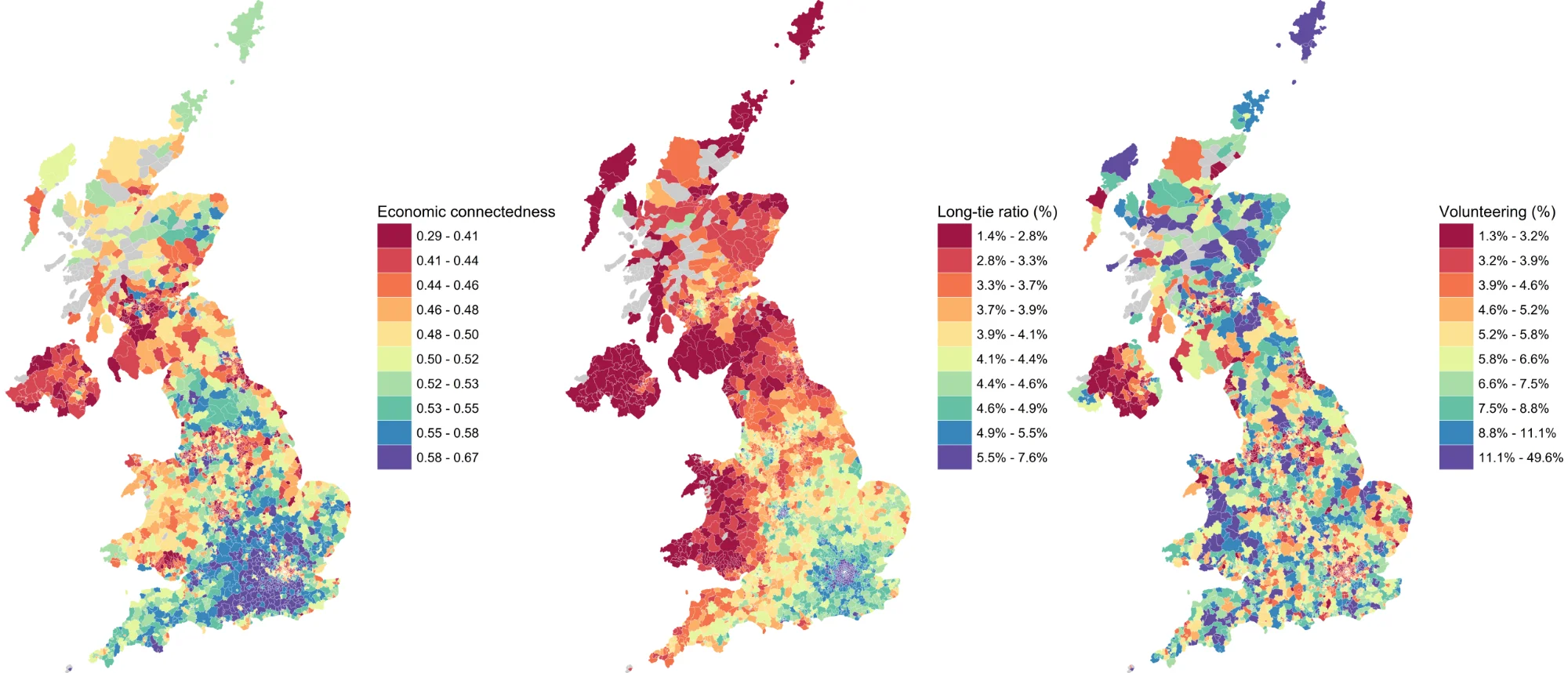
We construct a range of measures of social capital (the strength and structure of social networks) for the United Kingdom using data from Facebook covering 20.5 million adults. We make these measures publicly available. Low-socioeconomic-status (SES) individuals have far fewer high-SES friends than high-SES individuals do. Areas with more cross-SES friendships display higher levels of intergenerational economic mobility (higher adult earnings for children growing up in disadvantaged families). Most of the difference in connectedness to high-SES individuals between low- and high-SES individuals is due to differences in friending bias—the tendency of people to befriend others similar to themselves even conditional on the possible friends they are exposed to. Areas with more long ties (friendships between people with no mutual connections) also display substantially higher levels of intergenerational economic mobility, and long ties are especially likely to form outside the typical settings in which individuals make friends. The relationships between economic connectedness, long ties, and intergenerational economic mobility remain strong even after controlling for other area-level characteristics. We also make new estimates of intergenerational economic mobility in the UK publicly available, including the first estimates for areas in Scotland and Northern Ireland.
Work in Progress
Examining whether Americans migrate away from climate-risky areas and how insurance pricing affects these patterns, using IRS county-to-county migration data combined with FEMA risk indices.